
If you work in the construction industry and regularly claim CITB grant funding for NVQs, you might have heard there are big changes coming into effect in early 2026. These changes will affect how much you can claim, which qualifications attract funding and how grants are paid. At Portland Training we understand these updates can be confusing, so this blog post explains the new rules, what the changes mean in practice and how you can plan ahead to make the most of your funding.
What Has Changed and Why
In late 2025 the Construction Industry Training Board (CITB) announced a series of reforms to its training grants and funding offer. These changes are designed to make the grants scheme more sustainable in the long term because demand for funding has grown significantly while the overall levy rate has stayed the same. To ensure support continues for the greatest number of employers and learners, CITB is simplifying the funding structure and refocusing support on key areas.
The most important changes affecting NVQs and other qualifications take effect from 8 January 2026. Some transitional arrangements exist for training already booked or started before certain dates, but for new claims from January 2026 onwards, the rules are different.
What Happens to NVQ Funding
For many years CITB has provided different levels of grants for NVQs depending on their level and complexity. Higher level qualifications, especially supervisory and management NVQs, have attracted larger grant amounts. For example under the old scheme:
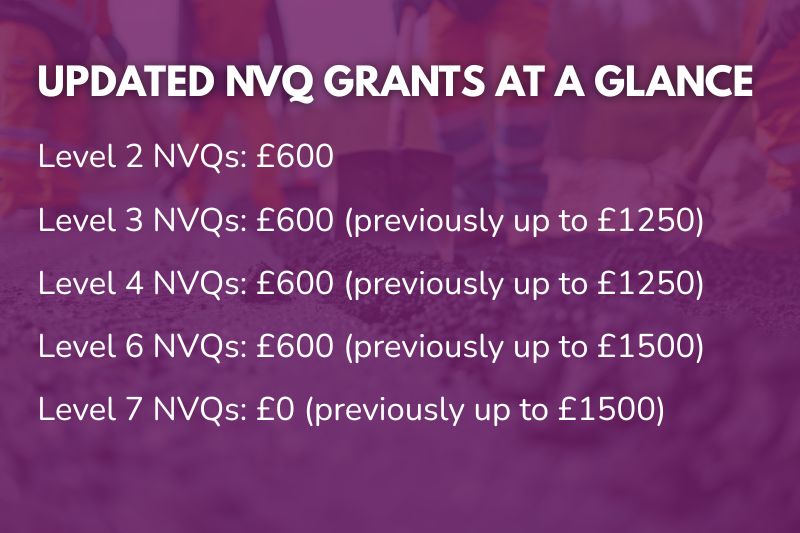
Level 2 NVQs typically attracted around £600
Supervisor NVQs (Level 3 or 4) could attract £1,250
Management NVQs (Level 6 or 7) could attract £1,500
These enhanced rates reflected the longer duration and greater value of these qualifications to employers and learners.
However, under the new funding rules, all non-apprentice achievement grants for long qualifications will be a flat £600 per completed qualification, regardless of level. This means a Level 3 supervisor NVQ or a Level 7 qualification will attract the same grant payment of £600 when achieved after the new rules take effect.
What About Attendance Grants and Long Qualifications
The old system included two components of funding for long qualifications like NVQs:
Attendance grants – smaller payments made throughout the training period
Achievement grants – a larger payment made when the qualification is completed
Under the new rules, attendance grants for long qualifications have been removed. Instead, only the achievement grant of £600 is paid when the qualification is completed.
For Level 7 qualifications, there are further changes. New Level 7 courses starting after 8 December 2025 are no longer supported for funding under the standard grants scheme, unless they were started by that date and completed within a specified transitional window with an application submitted by March 2026. The outcome is that in future, higher degree-related qualifications will not attract the same level of support they did previously.
Short Course Training and Other Changes
Although this blog focuses on NVQs, it is worth noting other funding changes that affect construction employers and workers:
Short vocational course grants are being removed from the standard Grants Scheme and replaced with employer network match funding at 50 per cent of eligible costs (with some health and safety courses funded at 30 per cent). This means courses such as SSSTS, SMSTS and other health and safety training will no longer attract the usual grant directly from CITB but must be supported by local employer networks.
CITB funding continues for apprenticeships and Scottish Advanced Craft Qualifications (SCQF Level 7), which are not affected by these changes.
What This Means for You
If you are in the middle of an NVQ programme or planning to start one, it is important to understand how these changes affect your funding claim:
If you finish your NVQ and claim the grant before 7 January 2026, you can still receive the higher grant rates that apply under the old rules. That could make a significant difference to your returns on training investment.
If you start an NVQ before 8 December 2025, but do not complete it until after the new rules apply, transitional arrangements may allow you to retain the old grant structure. It is important to check with CITB or your training adviser if this might apply to you.
From January 2026 onwards, new NVQ achievement claims will generally receive a standard £600 grant, so planning ahead to complete learning before the deadline could save money.
How Portland Training Can Help
Understanding these funding changes and navigating the CITB claims process can be confusing, especially when you are focused on running a business or completing a qualification. Portland Training specialises in delivering NVQs from Level 2 through to Level 7 and supporting employers and learners with grant applications and eligibility checks.
If you are unsure how much funding you can claim or want to know the best way to time your training investment, speak to one of our advisers. We can guide you through the updates, help you plan your training schedule and maximise the value you get from your CITB levy. Contact us today to discuss your options and secure the greatest possible funding for your team.