
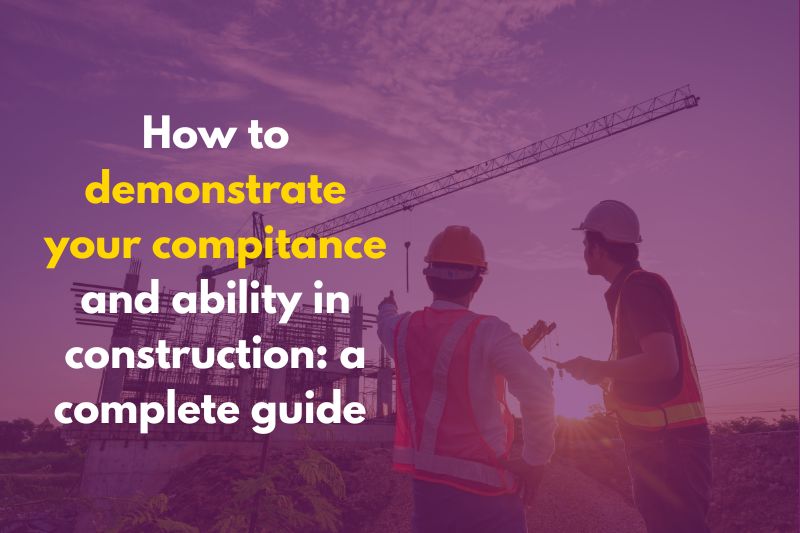
How to Demonstrate Your Competence and Ability in Construction: A Complete Guide
In construction, what actually gets you trusted with more responsibility is being able to demonstrate your ability, not paperwork alone. The NVQ system exists to do exactly that: to show you can genuinely do the job to a national standard, not just that you have attended a course. Your certificate, your portfolio and your CSCS card all exist to put that ability on record and on display.
This matters more than it might first seem. Construction is an industry built on trust in what people can actually do, since site managers, principal contractors and clients all need to know that the people on site can genuinely deliver, not just that they are experienced or qualified on paper. Knowing how to demonstrate your ability, and how to keep that evidence current, puts you in a much stronger position whenever a new opportunity comes up.
What does demonstrating your ability actually involve?
Unlike a classroom qualification, an NVQ is not assessed through an exam. It is assessed through your actual work, observed and evidenced over time. An assessor watches you carry out real tasks on site, asks questions to test your understanding, and reviews the evidence you build up as you go. This is what makes an NVQ a genuine demonstration of ability rather than proof of study: it shows you can do the job, in the conditions of the job, not that you can pass a test about it.
This is exactly why NVQs carry so much weight in the industry. A certificate on its own tells an employer very little. A certificate backed by assessed, real world evidence of what you can actually do tells them everything they need to know.
Your portfolio is where your ability is actually demonstrated
The heart of the process is your portfolio: site records, risk assessments, photos and videos of your work, and witness statements from colleagues or clients. This is the evidence your assessor uses to judge whether you are working to the standard, and it is the closest thing to a direct demonstration of what you can do.
Keeping a strong, well organised portfolio as you go makes demonstrating your ability far easier, both now and at your next level. Many people already generate most of this evidence simply by doing their job well, so the discipline is really in capturing it as you go rather than trying to reconstruct it later.

Your NVQ certificate confirms it, officially
Once your ability has been assessed and signed off, your NVQ certificate is the official confirmation. It shows that a recognised assessor has judged your work against national standards and found you able to deliver, not just present. Alongside the certificate, you will usually have Certificates of Unit Credit covering each part of the qualification, which can also support your evidence trail.
This certificate is worth holding onto carefully, since employers, awarding bodies and CSCS itself will all ask to see it at different points, whether you are applying for a new role, a new card, or your next NVQ level.
The CSCS card puts your ability on display, day to day
While your NVQ certificate confirms your ability has been assessed, the CSCS card is what actually gets checked at the site gate. It brings your demonstrated ability, your safety knowledge and your identity together into one piece of ID that site managers and principal contractors can verify at a glance.
This is exactly why getting your card sorted as soon as your ability is confirmed matters. Most major contractors and house builders will not let you onto a site, or trust you with more senior responsibility, without seeing the right card in hand, even if what you can actually do is not in question.
Backing it up with the CITB Health, Safety and Environment test
Alongside your NVQ, you will need a valid pass in the CITB Health, Safety and Environment test at the right level for your card, whether that is the Operatives, Specialist or Managers and Professionals version. This shows your safety knowledge sits alongside your practical ability, and it needs renewing every two years to keep your evidence current.
Between your NVQ, your test pass and your card, you end up with a joined up picture: what you can do, what you know about staying safe, and a card that shows both.
What evidence do you actually need to apply?
When you come to apply, CSCS asks for specific documents rather than just taking your word for what you can do. Typically this means your NVQ or SVQ completion certificate, along with any Certificates of Unit Credit, or if you are still working through your qualification, a letter or portal screenshot from your training provider confirming registration. If your ability has been recognised through a degree, HNC or HND instead, a completion certificate for that qualification does the same job.
Getting these documents together before you apply saves time, since incomplete applications are one of the most common reasons cards get delayed.

The real positive: demonstrating your ability at one level builds the case for the next
Here is where it gets encouraging. Demonstrating your ability at one level is never wasted once you move on, it becomes part of the evidence trail that makes the next level faster and more straightforward to demonstrate. A Level 2 NVQ shows you as a capable skilled worker and supports your Blue card. Build on that with a Level 3, whether through supervision or an Advanced Craft route, and you demonstrate a genuine step up, whether that is leading others or deepening your trade skill.
Keep going, and a Level 4 demonstrates site supervision ability, supporting a Gold Supervisor card, while a Level 6 or 7 demonstrates management level ability, the standard needed for a Black card. Assessors and employers can see a documented history of what you have already shown you can do, rather than having to take a leap of faith on someone new.
Take someone who started out labouring with a Level 2 NVQ and Blue card. By the time they are ready for a Level 6, they already have years of demonstrated ability behind them: a Level 2 assessment, a Level 3 or 4 assessment, previous portfolios, and a Gold card history on file. An assessor working through their Level 6 portfolio is not starting from zero, they are building on a track record that already speaks for itself.
This is one of the genuine advantages of the NVQ and CSCS system: every stage you demonstrate makes the next stage easier to show in turn.
Keeping your evidence up to date
Proof is not a one off task. CSCS cards typically last five years, and your Health, Safety and Environment test needs renewing every two years, so it is worth diarising both well ahead of expiry. Letting either lapse can mean a gap in your ability to work on site, even though what you can actually do never expires.
Renewing on time also means your evidence stays consistent and ready, so if an opportunity for your next card or role comes up unexpectedly, you are not caught having to scramble for paperwork.
Not sure how to demonstrate your ability?
Whether you are putting together your first application or working out what you need to demonstrate at the next level, it is worth checking exactly which evidence and tests apply to your situation before you apply, since requirements vary by card and route.
Get in touch with Portland Training today, and we can help you gather the right evidence, book the right test, and plan your route to demonstrating your ability at the next level.