
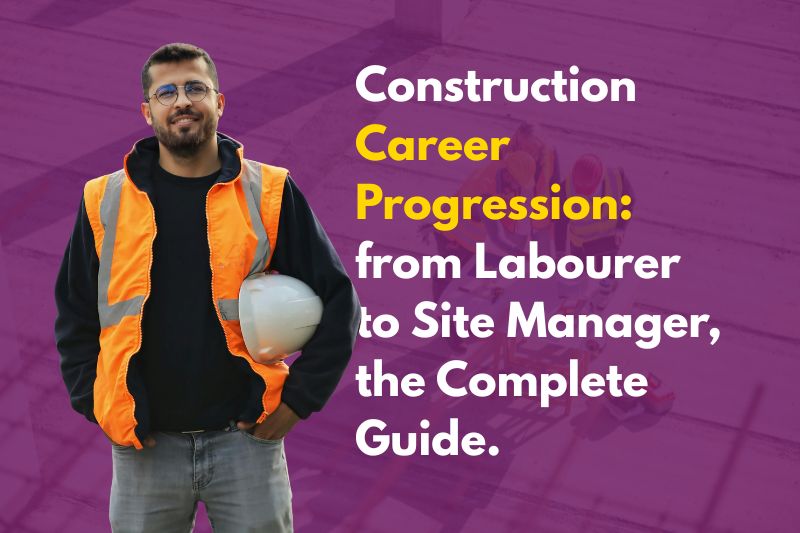
The path from labourer to site manager runs through a clear set of NVQ levels: Level 2 to start out, Level 3 and 4 as you move into supervision, and Level 6 to reach full site management. Each step is marked by a specific NVQ and, alongside it, a specific CSCS card. If you know where you sit now, you can map out exactly what comes next.
This guide walks through each stage of that ladder, the NVQ that matches it, and the CSCS card that goes with it, so you can see the whole route from your first day on site through to running one.
What does the construction career ladder actually look like?
Before going step by step, it helps to see the whole picture. The typical route runs from labourer, through supervisor and site supervisor, up to site manager, and on to senior manager or director level for those who want to keep climbing. NVQs sit alongside every stage, since they are the way the industry recognises that you can actually do the job at each level, not just that you have been doing it for a while.
Because NVQs are assessed through evidence from your day to day work rather than exams, moving between levels is less about starting again and more about building on what you are already doing on site. Each level layers extra responsibility onto the last, so your progress tends to mirror the responsibility you are already taking on, formal or not.
Starting out as a labourer: NVQ Level 2
Most people enter construction in a hands on labouring role, covering everything from site preparation and material handling to basic trade tasks. An NVQ Level 2 is the qualification that matches this stage, covering safe working practices and core competence in your trade.
This is also the level tied to the Blue CSCS card, which is what gets most workers onto site in the first place. It is not the end point, but it is the foundation everything else builds on, and the experience you gain here is exactly what an assessor will look for when you move up to Level 3.
Moving into supervision: NVQ Level 3
Once you are taking on more responsibility, guiding other workers or acting as a junior foreman, NVQ Level 3 is the next step. It covers areas like health and safety, coordination and basic team leadership, and starts to open the door to a Gold CSCS card.
It is worth knowing that there are two routes through Level 3, and they lead to the same Gold card in different ways. If you are moving towards supervising a team, a Level 3 NVQ in Occupational Work Supervision is the fit. But if you want to stay hands on and deepen your skills in a specific trade instead, such as bricklaying, carpentry or plastering, a Level 3 Advanced Craft NVQ recognises that expertise and leads to a Gold Advanced Craft card rather than a supervisory one. Both sit at the same level and both need around two years of relevant experience, but they suit different career goals.
This stage is really about proving you can be trusted with more than your own individual tasks, whether that means leading a team or being the person others come to for advanced technical know-how in your trade.

Stepping up to site supervisor: NVQ Level 4
NVQ Level 4 is aimed at site supervisors who are beginning to take on genuine management responsibility, such as coordinating multiple trades, managing resources and taking a bigger role in health and safety on site. It also sits alongside the Gold CSCS card, building on the supervisory ground covered at Level 3.
Candidates at this stage are usually running significant parts of a site day to day, even if they are not yet the named site manager.
Reaching site manager: NVQ Level 6
NVQ Level 6 is the big step up, and the qualification most people mean when they talk about becoming a site manager. It is equivalent to a degree with honours and is the primary route to a Black CSCS card, which is what most employers expect to see from anyone running a site.
At this level, you are expected to be managing budgets, resourcing teams, planning site activity and taking full responsibility for health and safety. It is a senior, evidence heavy qualification, reflecting the fact that a site manager carries genuine responsibility for the people and the project.
Most candidates reaching this stage have already built up several years of relevant experience, often alongside a Level 4 NVQ, since Level 6 assumes a solid grounding in day to day site management before you start.
Beyond site manager: NVQ Level 7 and senior leadership
For those looking beyond site management, NVQ Level 7 covers senior manager and director level roles, focusing on strategic leadership, contract management and oversight across multiple projects. It is equivalent to a master’s degree and can support progression towards CIOB chartered membership, alongside continuing to underpin your Black CSCS card.
This level suits people managing several projects at once, or those moving into a business leadership role rather than running a single site.

Which CSCS card do you need at each stage?
The CSCS card system tracks closely alongside the NVQ levels above. A Level 2 NVQ supports a Blue card, suited to skilled workers on site. At Level 3, your route determines which Gold card you end up with: the Advanced Craft route for experienced tradespeople, or the Occupational Work Supervision route for those heading into team leadership. Level 4 also supports a Gold Supervisor card, building on the supervisory route. Level 6, and Level 7 for renewal and continued senior status, support a Black card, the card most associated with running a site as manager.
Knowing which card matches which stage makes it easier to see exactly what your next NVQ needs to achieve, rather than working towards a qualification without a clear card or role in mind.
How long does each step take?
Because NVQs are built around evidence from your actual job rather than classroom study or exams, timeframes vary from person to person. Many candidates move through a level within a few months, particularly once their portfolio is underway and they are used to gathering evidence as part of their normal working week. Being busy on site is genuinely an advantage here, since it gives you a constant stream of material to draw on.
There is no need to take time away from work at any stage. Assessments are built around your existing role, whether that means an assessor visiting your workplace or working with you online.
Ready to move up? What to do next
Wherever you currently sit on the ladder, from labourer through to site supervisor, there is a clear next NVQ that matches your role and experience. The best way to plan your next step is to talk it through with an assessor who can look at what you are doing now and map out the most direct route to where you want to be.
Get in touch with Portland Training today to find out which NVQ is right for your next step, and how quickly you could be working towards it.